

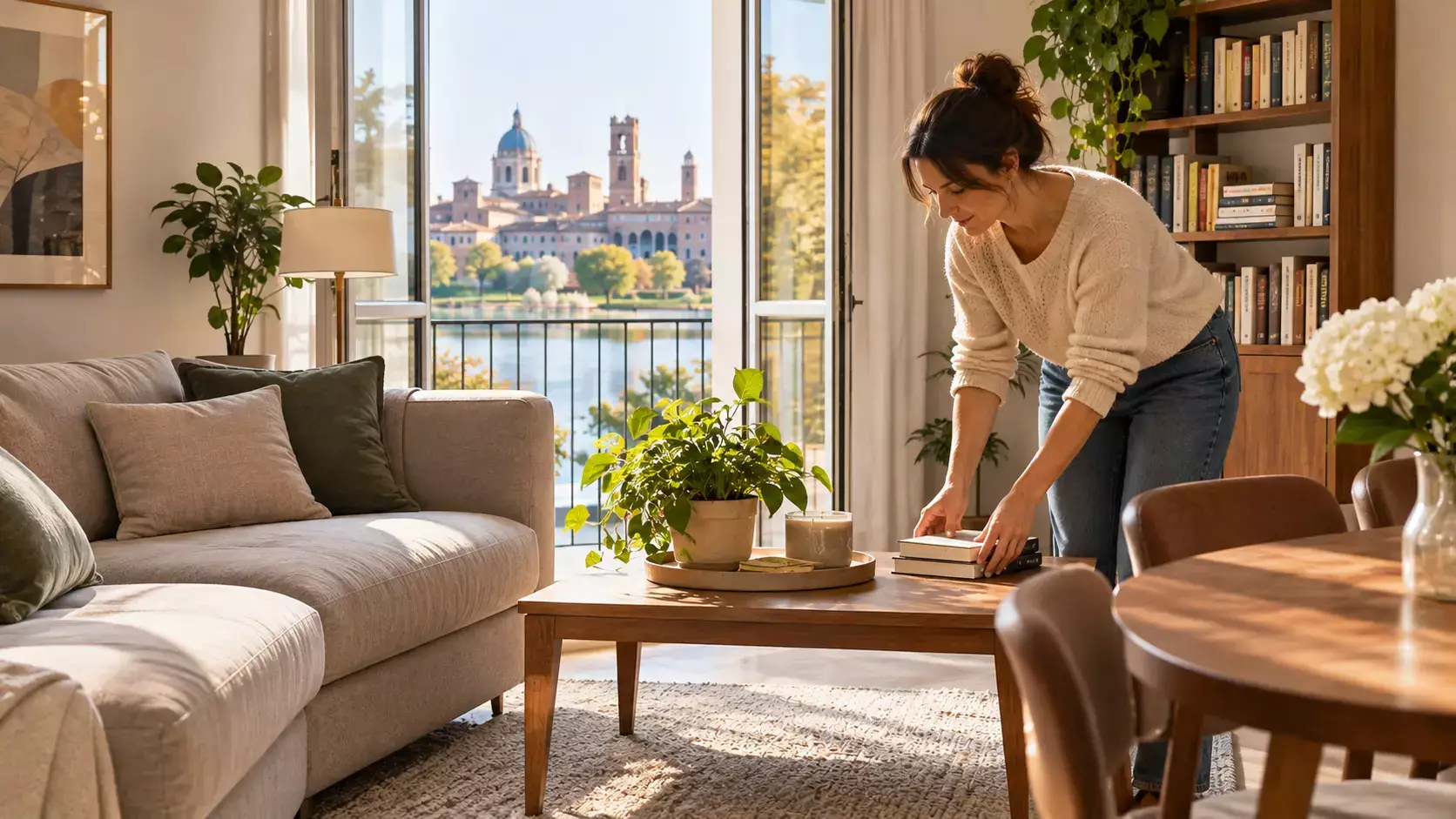
A home that is still lived in does not need to become an empty photo set. However, it should be tidy and visually clear enough for people looking at photographs or visiting the property to understand the spaces without being distracted by everyday belongings.
The distinction matters. Removing everything can make a home feel cold or difficult to understand. Leaving everything exactly as it is, on the other hand, can hide proportions, walkways, available space and key features.
The right approach lies somewhere in between.
The goal is not to erase everyday life from your home
When a home is still occupied, it is perfectly normal to have books, clothes, toys, kitchen utensils, photographs, documents and everything needed for daily life. Not everything has to disappear.
The question to ask is different: does this object help people understand the room, or does it draw attention to something unrelated to the property itself?
A table with four chairs gives a clear idea of the space available in a dining area. A table completely covered with papers, packaging, chargers and small objects, however, makes it harder to understand its size and purpose.
There is no need to make every room feel impersonal. The aim is to reduce visual clutter.
Start with the surfaces that help show the room's proportions
Before taking photographs, focus on the surfaces that help people understand the space.
Kitchen worktops, tables, bedside tables, low cabinets, desks and overcrowded shelves tend to become the focal point of an image. When these surfaces are clearer, it becomes easier to appreciate the walls, depth and walkways.
It may be enough to keep just a few items that reflect the room's purpose and temporarily move anything that creates clutter.
The goal is not to make the room look bigger than it really is. It is to prevent objects from making the space difficult to understand.
Protect your personal belongings before thinking about aesthetics
Some items should be removed not for aesthetic reasons, but to protect your privacy.
Personal photographs, documents, mail, medication, keys, calendars showing appointments, nameplates, screens displaying visible information and other sensitive items should not appear in property listing photographs.
Your home should be on display. Your private life should not.
Do not simply move everything into a room that will not be photographed
This is a common solution: clearing the living room and kitchen by piling boxes, bags and belongings into a spare room.
If you need to move some items temporarily, it is better to organise them in closed, easily movable containers or identify an area that can be quickly tidied before viewings.
If keeping your home presentable requires two hours of preparation every time a viewing is scheduled, the system is not practical.
Preparing for photographs and preparing for viewings are not the same
Photography requires more precise control over framing and composition. A viewing is different: people move around, change their perspective, open doors, look out of windows and experience the property in three dimensions.
Before photographs are taken, you need more careful tidying, clear surfaces and personal belongings kept out of the frame. Before viewings, you need clear walkways, accessible rooms and everyday items kept under control.
You do not need to recreate the exact appearance of the listing photographs every time. What matters is maintaining consistency between what people have seen online and what they find when they enter the property.
Do not hide features that will be obvious during a viewing
Preparing a property should never mean altering the reality of what is being presented.
If a room is small, reducing the amount of furniture or clutter can make it easier to understand, but it should not be used to create the impression that the room has different proportions.
Trust is built this way too: the impression created by the listing should match the experience of visiting the property.
If you have children, pets or a busy daily routine, your plan needs to be realistic
It is more useful to establish a few simple actions that can be repeated easily:
- clear the main surfaces;
- store small items in closed containers;
- remove personal photographs and documents before the photo shoot;
- keep the routes between the entrance and the rooms clear;
- agree on how much advance notice you realistically need before viewings.
A simple routine works better than a major transformation that is difficult to maintain.
In Mantua, the type of property also matters
A home in the historic city centre, an apartment in a building with an internal courtyard, a property on an upper floor, a home with connecting rooms or a more recently built house should not all be photographed and viewed in the same way.
That is why there is no single checklist that works for everyone. Every situation needs to be assessed individually and in detail.
Before taking photographs, try this simple test
Walk into each room and look at it as if it were not your own.
If the first thing you notice is a personal belonging, a collection of clutter, a cable, a stack of boxes or something that does not help communicate the space itself, it is probably worth moving it.
Your home does not need to look empty. It needs to be easy to understand.
If you are thinking about selling
If you are considering selling a home that is still occupied in Mantua or the surrounding province, you can start with an initial assessment of the property and how best to present it.